
Achilles at the Water's Edge
FORTUNE, FEAR, & FAVOR

Once upon a time, I was going to write an epic narrative poem. It began with Achilles on the beach, sitting by his tent, while he watched the waves curl along the shoreline and nursed his grievance. It was obviously based on the Iliad, but it would be about Viet Nam. And the sequel, which had the title Ithaca, would be about homecoming. It wasn’t my ambition that was mistaken, but the execution. I didn’t have the chops, for openers, and it wasn’t the most commercially viable idea. If you’re putting in the sweat equity, you want a return on the investment, something more like a movie deal than unsold copies from a vanity press.
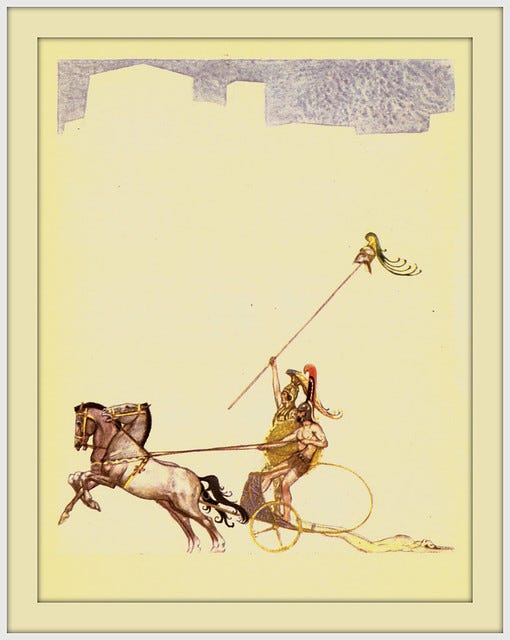
In different hands, maybe. Don Winslow’s recent trilogy, beginning with City on Fire, is about a mob war reimagined as the fall of Troy, and parallels the Aeneid. So it can be done, no question. (I particularly liked the moment when Hector’s character is run over, but his body gets caught on the exhaust, and he’s dragged through the streets of Providence. IYKYK.)
A shudder in the lions engenders there
The broken wall, the burning roof and tower
And Agamemnon dead
Yeats, of course, “Leda and the Swan,” the fated collision, violent and frightening, the brute god indifferent to the outcome. War, notoriously, has unintended consequences. It’s said that no plan survives first contact with the enemy. And the curse on the House of Atreus descends to Agamemnon’s children, the son avenging his father’s murder but pursued by the Furies for his crime. There seems no end to the unraveling. We set great engines in motion, and they lure us to our destinies, already woven in the loom.
The choice offered Achilles is between living to a comfortable old age, and his name soon forgotten, or an early death, but undying fame. We know which fate he decides on. He is, perhaps, spared disillusion. In the darkness, just beyond the firelight, Ajax falls on his own sword, from shame, because he’s been denied the armor of Achilles. Are these Greeks of the Bronze Age somehow different in character, or virtue, from the people we hope we might be? Are we talking about honor, or aspiration, or is it simply performance, an overly dramatic self-regard?
There’s a theory that our consciousness is different in kind from the culture of Mycenaean Greece. They hear the voices of the deep; we prefer to think this is metaphor, or bipolar disorder. But it’s entirely reasonable to imagine the past as a foreign country, where we not only don’t speak the language, or understand the currency, we can’t reference a common myth, that explains our relationship to the physical world, because they inhabit other worlds - the unseen, the divine, the elemental, held at bay by magic.
We understand ourselves too quickly. Everything can be conditional, subject to mathematics and the laws of physics, human endeavor is quantifiable and transactional. We’re captive to animal basics, hunger, rescue from the cold, sexual release. We are earthbound. The heroes are a memory of men who contested with gods.