
Running on Empty
IDENTITY POLITICS & INNER EXHAUSTION

I’ve been thinking about cognitive dissonance, lately. There’s so much information thrown at us, and so little possibility of ordering it. Too many voices clamoring for our attention. You can’t weigh them in the palm of your hand, like a canteloupe. We’ve got no framework for comparison. How do you measure a figure of speech? Can we calculate its specific gravity?
I’m beginning to wonder if MAGA isn’t in the same boat as the rest of us. It’s too easy to imagine the psychological stresses we’re under are only being suffered by people we’re in political sympathy with, when it seems to be the case that everybody’s cracking under the strain. Recent polling suggests that 80% of Republicans are satisfied with the way things are going; they must define those words differently, way, things, and going. I see only a brute malevolence, the manufacture of chaos. Apparently, we’re living in competing realities. Or maybe it’s something else, maybe it’s in fact the same reality, but we’re using different coping mechanisms. We’re all coming apart at the seams, and no one has an exclusive on rescue or remedy.
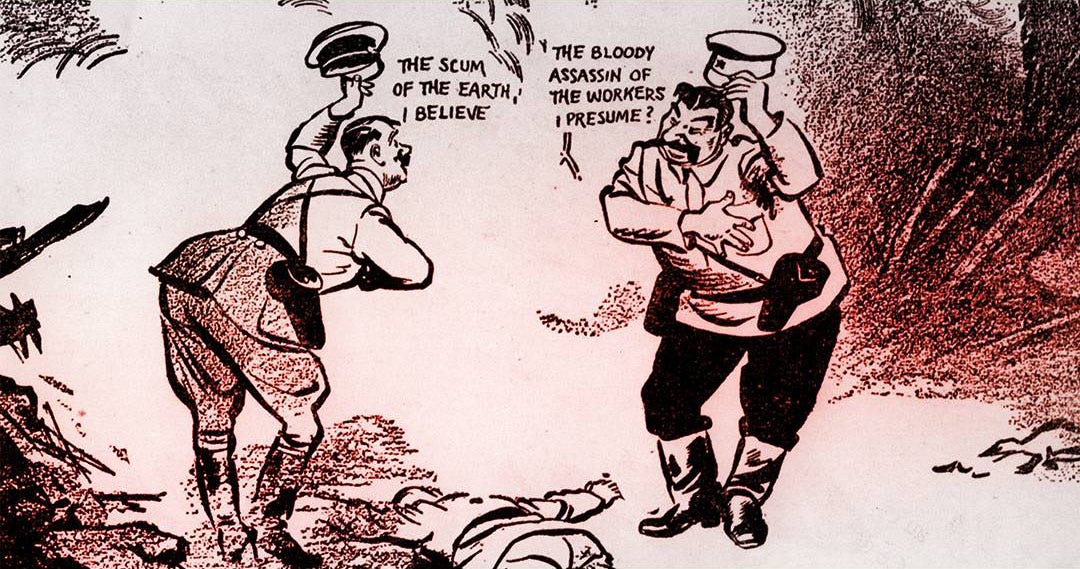
Here’s the historical parallel I come up with. I mentioned the Hitler-Stalin Non-Aggression Pact in my column last week, writing about Casablanca, and I realize not everybody will necessarily get the reference. The background is this. Nazi Germany and Soviet Russia made a deal, in August 1939, not to attack each other, and while they were at it, they divvied up the countries in between. Russia would take Finland, Latvia, and Estonia; Germany would take East Prussia and Lithuania. They’d split Poland. Hitler was confident, after humiliating Chamberlain at Munich, that Britain and France would do nothing, but he was protecting himself against a war on two fronts, East and West. Germany invaded Poland on September 1st, and two days later, France and Britain both declared war on Germany.
For our immediate purposes, we don’t have to get into a lot of specifics, about the early days of the war. That’s another conversation, and a wider one. I want to keep our attention on the devil’s bargain Hitler made with Stalin, and actually not even the pact itself, so much, but how it was perceived. The consequences of the pact were serious enough, on the battleground; they were of a different order in the political world.
In the 1930’s, the Left and the Right were locked in a bitter, murderous struggle. Hitler came to power, in part, because of it: the Nazis piggybacked on resentments. In the streets of Berlin, the Communists and the revanchists were demonstrating against each other, and beating each other to death with pick-handles and paving stones. Not an exaggeration. All across Europe, right-wing sentiment was gaining traction, anti-Red hysteria the driving force. The big showdown, theatrically speaking, came in Spain. The civil war between the Loyalists and Franco’s falange began in 1936, and went on with increasing savagery on both sides until 1939, when Franco took Madrid. In some respects, Spain was a dress rehearsal for WWII, a proxy war, although many countries, the U.S. included, maintained a fiction of non-intervention. Mussolini signed on in support of Franco, Germany sent the Condor Legion. Foreign volunteers for the Republicans fought in the International Brigades, supported by Soviet military advisors; the NKVD was a major presence, behind the lines. In popular mythology, or metaphor, Spain was a codeword, for where you stood, for or against the reactionary Fascist Right.
This is why the Hitler-Stalin pact created such a crisis of conscience on the Left. It was utterly disorienting. Nobody knew whether to shit or go blind. Before it became the official Kremlin line, in fact, rumors of the secret negotiations were denounced as Nazi propaganda. American Communist leadership had favored collective security, a common defense against Fascist dictatorship; suddenly, they were tacking into shifting winds from Moscow, that the war fever in Britain and France was serving the interests of capital, and that they were the aggressors, wanting to keep Germany under their heel, a vassal state subject to the punitive terms of the Versailles Treaty. The national Communist parties in France, the UK, Czechoslovakia, and others, were instructed to reverse course, as well. They’d voted to support defense; now they should oppose it. The contortions and contradictions have a comic element, but they actively hampered the Allied war effort. Lefties who’d fought for the Loyalists in Spain wouldn’t sign up to fight Hitler in the much bigger European ground war. They were regarded with scorn in many quarters, their principles clearly a matter of Stalin’s convenience.
This weird, counterintuitive, symbiotic relationship - between two deeply paranoid, malevolent overlords, and two poisonously antagonistic political philosophies – lasted just shy of twenty-two months, and then Hitler, having abandoned SEA LION, the cross-Channel amphibious assault on England, launched Operation BARBAROSSA, the invasion of Russia. By all reports, Stalin refused to believe the initial intelligence, which lost his generals a critical first response, but the blitzkrieg of June stalled out in the snows of December, and the Red Army had recovered their wits by then. They gave no more ground.
The casualty numbers on the Eastern Front are uncertain. German military losses were a million-plus; Russian losses four-and-a-half million. That’s one statistic. 10 million combatants, eighty per cent casualties, other sources say. Prisoners of war deliberately starved to death. At least a million Russian Jews murdered by Waffen-SS units and the Einsatzgruppen. How many civilians, targeted randomly? Nobody knows. It’s the largest military offensive in human history, and it changed history.
Here’s one consequence. The political Left had been holding their breath, and when Hitler stabbed Russia in the back, they were able to let it out. As suddenly as they had before, they reversed course again. It was fashionable once more, and expedient, to hate the Nazis. You weren’t labeled a Premature anti-Fascist, which is what the Lincoln Brigade guys were called, who fought in Spain. They were suspect beforehand, because they declared too early. Then their loyalties were suspect after the fact, when they came to the fight too late.
It’s enough to make your head spin. How do you square reality with a moral imperative? Not to make a value judgment about which moral imperative, either. You might think those radical Lefties in the 1930’s were foolish, or naïve. You wouldn’t get an argument from me. I might think MAGA is foolish, or bone-headed. But suppose MAGA is the one getting whiplash, now?
Riddle me this. You’re a Trump voter, and you’re maybe halfway engaged with what’s going on, about as much as the average Joe. If it were me, at this point, I’d have some doubts. But we all have core essentials. A sense of self, how we address the world around us. You can’t disallow that, it’s hard-wired. Then again, is MAGA’s support for Trump really so co-dependent that withdrawal would bring on identity collapse? I’d think it was more like trying to escape an abusive relationship. The gaslighting, the empty promises, the tantrums. Just as a lot of those idealistic Lefties from the 1930’s had a hard time breaking up with Communism, because they were in effect breaking up with their own innocence and hope, many Trump supporters have a similar set of obstacles to get over. They’ve invested too much to give it up.
Think of it this way. Some of those old Lefties never gave up, either, and history’s left them behind.